
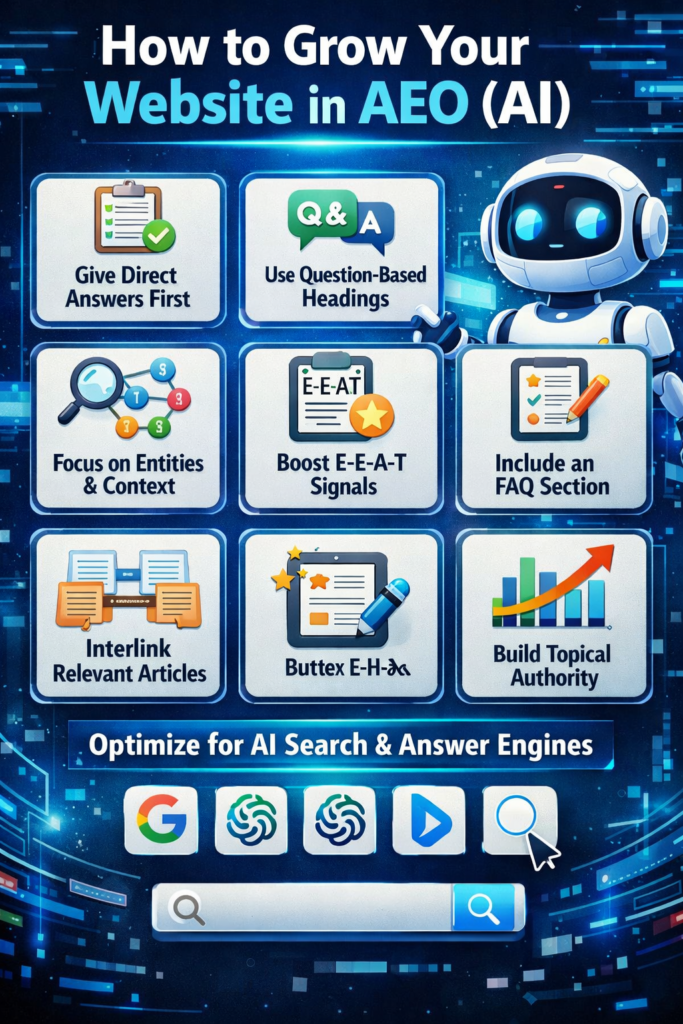
Artificial intelligence search engine optimization is the art of making your site readable, reachable and acceptable by artificial intelligence based search engines so that it can be used by the system in creating responses. The blue links are no longer the features of the searches in modern platforms like Google and Bing, which can summarize the information with the help of AI models created by such companies as OpenAI.
AI SEO is more transparent, more organized, more authoritative, and purposeful than merely repetition of the keywords. It is a way to make sure your content is formatted in a manner which allows the AI tools to extract, interpret, and present it to search users with high confidence in conversational search result and AI summaries.
If you want your website to appear inside AI-generated answers, you need more than traditional SEO. Following are the needful
- ✅ AEO (Answer Engine Optimization)
- ✅ GEO (Generative Engine Optimization)
- ✅ Entity-based SEO
- ✅ Strong E-E-A-T signals
Let’s break it down step by step.
What Does It Mean to Rank in AI?
Ranking in AI doesn’t always mean being #1 on Google.
Instead, it means:
- Your content is quoted or summarized in AI answers
- Your brand is mentioned in AI-generated responses
- Your website is used as a trusted source
AI systems prioritize:
- Clear answers
- Structured information
- Authoritative sources
- Entity clarity
Following are the step that be used to get your website in Artificial intelligence
Step 1: Optimize for AEO (Answer Engine Optimization)
AI prefers direct answers to specific questions.
How to Do It:
- Start articles with a 40–60 word direct answer
- Use question-based headings:
- What is…?
- How to…?
- Why does…?
- When should…?
- Add FAQ sections
- Use bullet points and tables
Example of AI-Friendly Formatting
Q: How to rank a website in AI?
Structured data, well-organized question-answer formatting, semantic keywords, and high authority can be used to ascend the AI search results list. Pay attention to the AEO and GEO strategies and enhance the level of trust and topicality.
That’s how AI likes content — simple, structured, and clear.
Step 2: Use Structured Data (Schema Markup)
AI tools rely heavily on structured data.
Add:
- FAQ Schema
- HowTo Schema
- Article Schema
- Organization Schema
- LocalBusiness Schema
This helps AI understand:
- Who you are
- What your business does
- Where you operate
- What your page is about
Without schema, AI has to guess. With schema, AI understands instantly.
Step 3: Focus on Entity-Based SEO
AI understands entities, not just keywords.
Instead of repeating keywords, clearly mention:
- Locations
- Brands
- Services
- Industry terms
Example:
If you target Auckland, mention:
Auckland
This strengthens contextual understanding and improves AI trust signals.
Step 4: Build Topical Authority
AI ranks websites that fully cover a topic.
Instead of writing one article, create a content cluster:
If your niche is digital marketing:
- What is SEO?
- How does SEO work?
- SEO vs PPC comparison
- Technical SEO checklist
- Local SEO guide
Internal linking between these articles builds authority.
AI prefers complete ecosystems, not single pages.
Step 5: Improve E-E-A-T Signals
AI evaluates:
- Experience
- Expertise
- Authority
- Trust
To improve:
- Add author bio with credentials
- Show business address and contact details
- Publish original insights
- Collect customer reviews
- Get niche backlinks
Trust is a major ranking factor in AI-generated answers.
Step 6: Optimize for Conversational Search
AI users search differently.
Instead of:
SEO tips
They ask:
How can I rank my website in AI search results?
So your content must:
- Use natural language
- Answer conversational queries
- Include long-tail questions
- Add comparison tables
Step 7: Technical SEO Still Matters
AI pulls data from search indexes.
Make sure your site:
- Loads fast
- Is mobile-friendly
- Has clean HTML structure
- Uses internal linking
- Has an XML sitemap submitted
Without technical optimization, AI may never properly crawl your content.
Traditional SEO vs AI SEO
| Factor | Traditional SEO | AI SEO |
| Focus | Keywords | User intent + entities |
| Ranking | SERP position | AI answer inclusion |
| Content Style | Long-form blogs | Structured answers |
| Authority | Backlinks | Trust + expertise signals |
| Format | Paragraph-heavy | FAQ + tables + bullets |
Advanced Tips to Rank in AI (2026 Strategy)
- Add FAQ schema on every service page
- Publish original research or statistics
- Create branded content
- Optimize for voice search
- Use clear definitions
- Keep paragraphs short
- Maintain consistent publishing
Final Formula to Rank in AI
Clear Answers + Structured Data + Entity SEO + Authority + Topical Depth = AI Visibility
Get more on – Shericodes